A technician stuck in traffic with a truck full of chemicals is not making money. Every extra mile, every backtrack, every last-minute reschedule quietly eats into margins. For pool service companies, the route is the business. Tight, intelligent routing turns the same crews, trucks, and hours into more stops, happier customers, and far better profit per day.
That shift matters as the industry scales. The U.S. pool maintenance and cleaning services market is projected to reach $10.33 billion by 2029[source]. Competition will tighten, customer expectations will rise, and the operations that win will be the ones that treat routing as a strategic lever, not just a daily chore for the dispatcher.
Pool route optimization is not just about drawing cleaner lines on a map. It is about using data, software, and smart processes to control cost, reclaim time, and deliver more consistent service across hundreds or even thousands of properties. The right approach can transform how a service company plans its days, manages technicians, and scales into new territories without losing control.
Why Pool Route Optimization Matters More Than Ever
Most pool businesses already try to “keep routes tight,” yet many still leave a double-digit percentage of potential efficiency on the table. Optimized pool service routes can save companies up to 30% on operating costs and increase the number of pools serviced per day by 25%[source]. That kind of swing can mean the difference between barely covering overhead and funding growth, new trucks, or higher wages for top technicians.
The cost impact is not only about labor. Service companies can save up to 20% in fuel costs by leveraging route optimization technology[source]. With fuel pricing often volatile and routes repeating weekly, every unnecessary mile is a recurring, compounding expense. Tight routes stabilize a big line item on the P&L and free cash for marketing, hiring, or equipment upgrades.
Demand is there to support this investment in efficiency. Approximately 60% of pool owners in the U.S. hire professional services for pool maintenance[source], and the wider swimming pool market was valued at about $7.6 billion in 2020[source]. As more homeowners outsource maintenance, providers that can service more pools per technician without sacrificing quality will capture a larger share of that spend.
What an Optimized Pool Route Actually Looks Like
Route optimization is often misunderstood as simply grouping nearby stops. Location matters, but an optimized pool route balances distance with time windows, traffic patterns, service complexity, technician skill sets, and even inventory needs. The result is a schedule that looks realistic to the dispatcher and feels achievable to the technician in the field.
A well-structured route tends to have predictable start and end times, minimal crisscrossing, and a clear rhythm throughout the week. Regular weekly clients fall into a consistent pattern, while one-off jobs are slotted where they cause the least disruption. Instead of reshuffling routes every time a new customer signs up, the business relies on a framework that absorbs growth with limited chaos.
Customers feel the benefit when routes are tuned. Shorter travel time reduces delays and missed windows. Technicians arrive on site prepared, knowing the pool’s history, equipment, and prior issues. That kind of reliability is hard to replicate without intentional route design backed by software and data.
Key Inputs That Drive Route Quality
The strongest pool routes lean on a mix of operational data and real-world constraints. Address and location are the starting point, but not the only factor that matters. Visit frequency, average service time, whether a property is commercial or residential, and whether access has restrictions all feed into better planning.
Technician profiles matter just as much. Some teams specialize in repairs, others in standard maintenance. Matching the right person to the right pool reduces revisits and time spent troubleshooting. When technicians have routes tailored to their strengths, work feels smoother and productivity rises naturally.
Seasonal demand spikes are another important input. Summer surges, storm cleanups, and opening and closing seasons can distort routes quickly. A flexible optimization approach helps absorb these peaks without exhausting the team or dropping the level of service customers expect during the busiest months.
How Route Optimization Software Changes the Game
Doing all of this by hand with paper maps or basic calendar tools quickly hits a ceiling. That is where specialized pool service and route optimization software becomes central to operations. These platforms ingest customer data, technician schedules, and traffic information, then generate routes that align with business rules and service standards.
One of the most powerful shifts is real-time visibility. Dispatchers and managers no longer guess where a technician might be or whether they are on pace. The schedule is live, updated as jobs are completed or rescheduled. That visibility makes it possible to adjust mid-day when an emergency call comes in, a technician calls out sick, or a customer requests a last-minute change.
Access to customer information on-site is just as transformative. As one industry expert noted, “Being able to access client profiles instantly when on-site has changed how we approach our services”[source]. When route optimization lives inside the same platform as customer history, technicians stop wasting time hunting for notes and can instead move confidently from stop to stop.
Core Capabilities to Look For
Not all routing tools are built with pool service operations in mind. The most effective platforms share a few traits: they handle recurring schedules gracefully, support different visit frequencies, and allow for constraints like technician certifications or access requirements. Route building should feel fast, but also controllable, with the ability to override or fine-tune specific stops when needed.
Mobile access is another non-negotiable. Technicians need turn-by-turn directions, job notes, water chemistry history, and photo logging in their hands, not sitting on a desktop back at the office. When the mobile app updates job statuses instantly, office staff can see progress in real time and adjust the rest of the day accordingly.
Finally, reporting built into the platform makes optimization a continuous process, not a one-time project. Tracking metrics such as average stops per day, drive time versus on-site time, and on-time arrival rates helps identify which routes are working and which need refinement.
Step-by-Step: How to Start Optimizing Your Routes
The most successful route optimization efforts start with clean, complete data. That means accurate addresses, confirmed service frequencies, realistic time estimates per job, and up-to-date technician schedules. Before any algorithm can help, the foundation must be reliable. Taking a short period to standardize this data pays off quickly once optimization begins.

From there, the next step is to group customers logically by geography and frequency, then let software propose route structures. This first pass gives a baseline. Dispatch can then layer in practical knowledge: roads that are slower than the map suggests, tricky parking situations, or properties that tend to run over their scheduled time. Over the first couple of weeks, feedback from technicians helps refine the assumptions baked into the system.
Once the structure stabilizes, changes to the route should be deliberate. New customers should be slotted into existing routes where they truly fit, not wherever there seems to be an open spot on the calendar. When a route starts to feel overloaded, it is time to consider splitting it or adding capacity, rather than stretching technicians thin and hoping for the best.
Using Optimization to Support Growth, Not Just Efficiency
Route optimization is often pitched as a way to save money, and the cost savings are very real. But the same mechanics that reduce expense also create room to grow. When optimized routes allow a company to service up to 25% more pools per day with the same or similar resources[source], it becomes far easier to say yes to new customers without degrading service for existing ones.
This mindset mirrors what other sectors have seen from smart “pooling” strategies. For example, the use of pooling in irrigation systems has increased crop yields by an average of 20% in some studies[source]. The underlying principle is similar: smarter allocation of limited resources produces more output. For pool service companies, those resources are technician hours, truck capacity, and fuel.
Businesses that build optimization into their growth plans can expand into new neighborhoods or cities with far less trial and error. Every new cluster of customers slots into a routing framework that is already designed to handle density, frequency, and technician specialization.
Benefits Beyond Miles and Minutes
Time and fuel savings are the obvious gains, but well-optimized routes create a ripple effect across the whole business. Technicians experience less stress when their days feel achievable and coherent. They spend more time actually servicing pools and less time fighting traffic or racing between distant stops. That shift makes it easier to retain experienced staff and ramp up new hires.
Customers notice the difference in reliability. Consistent arrival windows and fewer surprise delays increase trust. That consistency is especially valuable in a market where a majority of pool owners already pay for professional maintenance[source]. When expectations are high, operations that can show up on time, week after week, stand out.
Better routing also helps inventory management. When the platform tracks which technicians visit which pools and when, it becomes easier to load trucks with the right chemicals, parts, and tools for the day. Fewer return trips to the warehouse mean even more hidden time savings on top of the mileage gains.
Environmental and Community Impact
Reducing unnecessary miles does more than protect the bottom line. Fewer hours on the road mean lower emissions and less traffic in the communities served. There is a parallel here with broader water and resource management trends. Pooling systems in urban infrastructure have been shown to reduce water wastage by up to 40% in some contexts[source], underscoring how smarter resource coordination can deliver meaningful environmental benefits.
Pool service companies that operate efficiently can lean into this narrative with customers. Modern homeowners are increasingly sensitive to how their service providers impact the environment. Being able to point to optimized routing, reduced fuel consumption, and smart scheduling can strengthen brand positioning and support premium pricing.
Common Route Optimization Mistakes to Avoid
Many businesses attempt route optimization once, see modest gains, and then slip back into old habits. A frequent mistake is treating initial route designs as static. As customers churn, move, or change service levels, routes drift out of alignment. Without a process to review and adjust them regularly, the system gradually loses its edge.
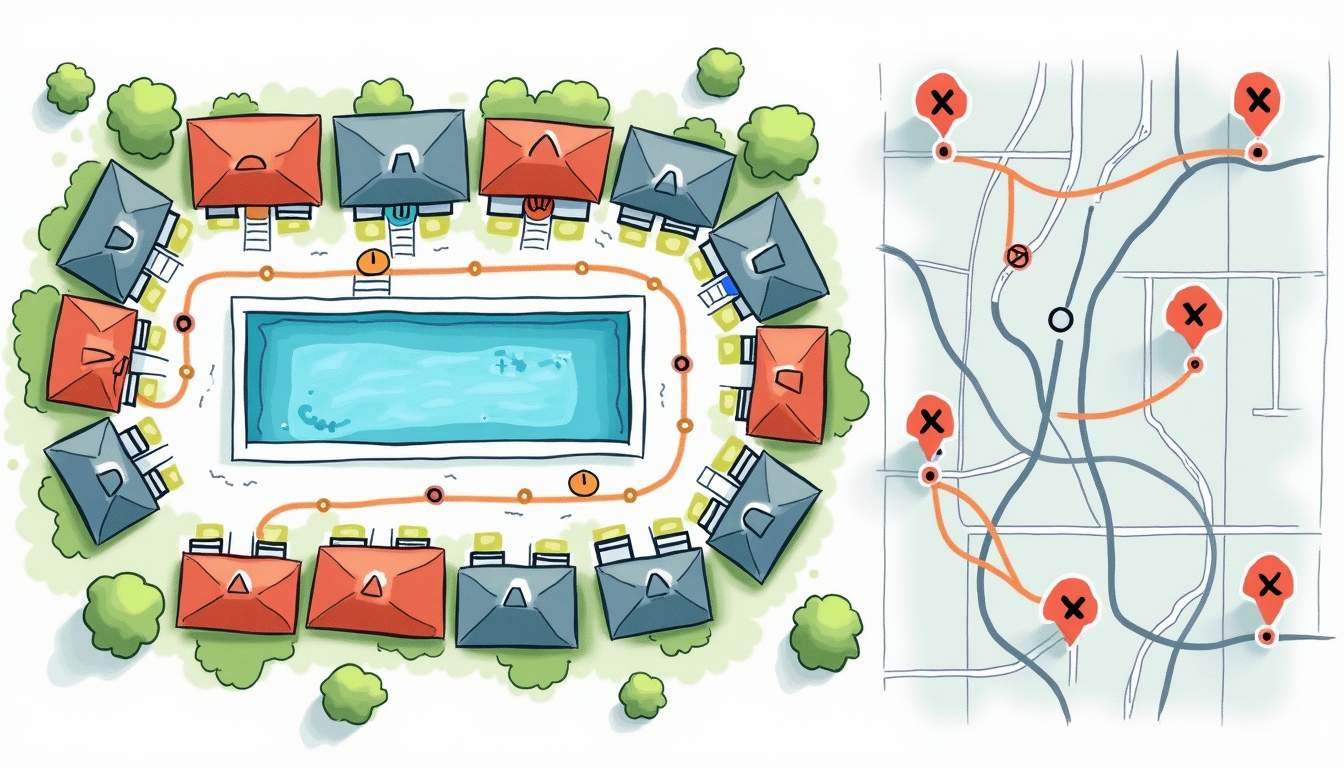
Another pitfall is ignoring technician feedback. Optimization that looks perfect on a screen can feel unrealistic in the field. If technicians report that certain pools always take longer than scheduled, or that a particular sequence causes constant delays, that information needs to flow back into the planning engine. Otherwise, routes that are “optimized” on paper create frustration instead of efficiency.
Over-focusing on pure distance is also risky. The shortest path is not always the fastest or most reliable. Construction, school zones, seasonal traffic, and narrow streets can make slightly longer paths more practical. Good optimization balances algorithmic suggestions with local insight from people who drive these neighborhoods every day.
Measuring ROI on Route Optimization
For leadership, the question is not whether route optimization works in theory, but how to prove its value in practice. The most straightforward approach is to benchmark key metrics before and after implementation. These typically include average pools serviced per technician per day, total miles driven per day or week, fuel spend, overtime hours, and on-time arrival rates.

The industry data helps frame expectations. If optimized routes can reduce operating costs by up to 30% and increase pool visits per day by 25% in some operations[source], even capturing a portion of that range can justify investment in software, training, and process change. When route optimization also cuts fuel costs by up to 20%[source], the payback period typically shrinks further.
What matters most is to track these numbers consistently and share them with the team. When technicians can see that new routing practices reduce windshield time and overtime, buy-in grows. When managers can point to hard data showing more revenue per truck or per technician, route optimization becomes a cornerstone of strategy, not just an operational tweak.
The Future of Efficient Pool Service Operations
The pool service market is on a growth trajectory, with the U.S. maintenance and cleaning segment alone expected to reach $10.33 billion by 2029[source]. As that expansion continues, the gap between manually managed operations and software-driven, data-informed businesses will widen. Route optimization sits at the center of that divide.
Platforms that already integrate scheduling, routing, customer management, billing, and field mobility will continue to push the standard higher. Real-time traffic data, predictive service timing based on history, and smarter clustering of new clients are quickly moving from “nice to have” to baseline expectations for serious service providers.
Companies that act now to modernize their routing approach will not just save time today; they will build the operational backbone needed to scale into new territories, absorb acquisitions, or add complementary services without losing control of their day-to-day. Optimization is no longer a side project. For pool service businesses aiming to lead their markets, it is becoming core infrastructure.