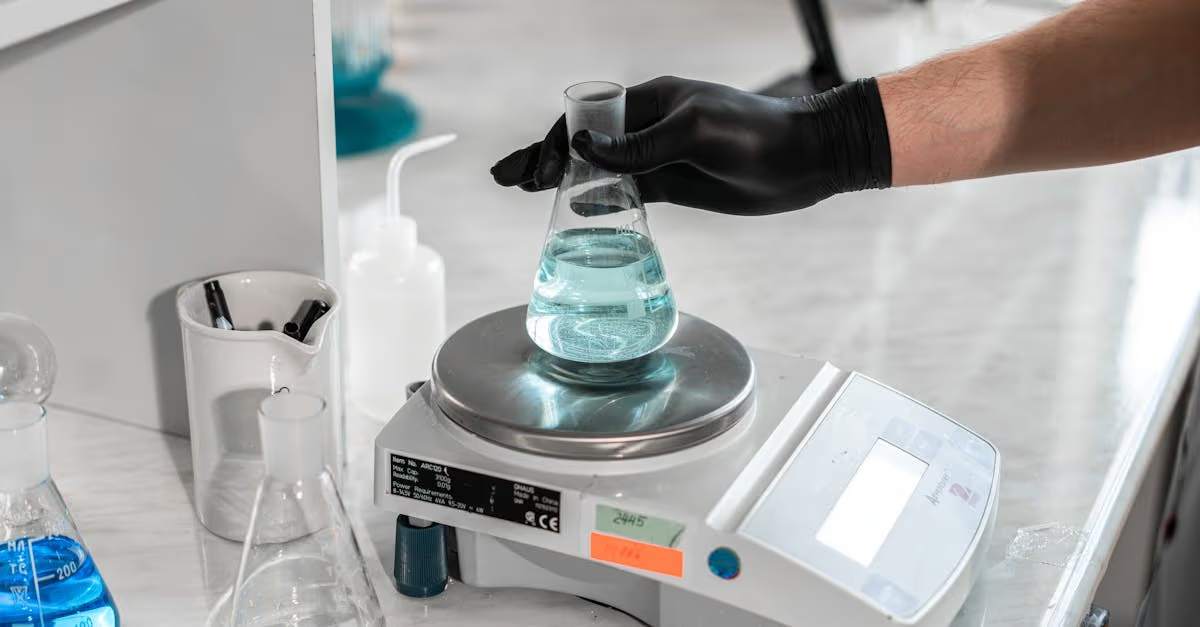
Disciplined pool chemical balancing for route-based service companies: clear targets, dosing rules, technician workflows, and systems that protect profit.
TL:DR
- Treat chemical balancing as a repeatable system, not a daily guess.
- Standardize targets, tolerances, and dosing rules by pool type and season.
- Use software to enforce workflows, document proof of service, and protect margin.
Best Fit
- Route-based, recurring service businesses that want standardized chemistry and tight documentation.
- Owners who care about retention, margin, and reducing technician-by-technician "art projects."
Not Best Fit
- One-off, emergency-only or appointment-driven trades with no recurring routes.
- Owners who prefer ad-hoc decisions over consistent systems and measured dosing.
If you run pool service routes, you already know this: water problems rarely start at the water line. They start in the system.
Missed readings. Inconsistent targets. Guesswork dosing. No history when a homeowner questions a stain or scale. One technician quietly "does their own thing," and three months later you inherit a mess you can't see on a P&L, but you feel in callbacks, credits, and churn.
This guide treats pool chemical balancing the same way you treat routing and billing: as a system. The goal is not perfect water. The goal is a repeatable, teachable, and documented process that any competent technician can run on every stop.
Along the way, we'll also show where ProValet's operating system helps you turn that discipline into fewer disputes, faster collections, and more trust with homeowners.
Why Chemical Balance Is A Systems Problem, Not Just A Water Problem
Most owners frame chemistry as a technical problem: pH, alkalinity, chlorine, stabilizer. That's true on the surface. But when you zoom out across 200–1,000 stops per week, chemical balancing becomes a systems problem.
The real risk is not one bad pool. It is inconsistent decisions multiplied by routes, seasons, and techs.
Where chemistry really breaks down
- No standard targets. Each tech holds a different "good enough" in their head. One runs pH at 7.2–7.4, another is fine with 7.8. Over time, that inconsistency shows up as scale, corrosion, and algae risk.
- No defined tolerances. You either treat or you don't, based on feel. That creates over-dosing on some pools and chronic under-dosing on others.
- Guesswork dosing. Techs "splash a little extra" instead of using rules tied to pool volume and current readings.
- No structured visit history. When a homeowner complains about stains or eye irritation, you're arguing from memory instead of pulling up three months of documented readings and actions.
- Seasonal drift. Targets that worked in mild weather fail in August heat, but no one ever updated the playbook.
The business didn't get worse. It just got bigger than the systems holding it.
Route-based, recurring service businesses can't rely on heroics. You need structure:
- Standard chemistry targets by pool type and season.
- Clear tolerances that trigger action (or no action).
- Dosing rules in ounces and pounds, not vibes.
- Visit documentation that is automatic, not optional.
This is the mindset shift: chemistry is not the art of the senior tech. It's a controlled process the whole team can run, backed by software that makes it visible.
ProValet is the automation-first operating system for route-based, recurring service businesses. We Automate Trust™ by making this kind of discipline the default instead of the exception.
Core Water Chemistry Metrics You Must Control On Every Visit
You can measure a lot in a pool. For route work, you don't need every lab metric. You need a tight core set you can track on every stop, every week, without fail.
At minimum, your standard visit should capture:
- Free Chlorine (FC) – Active sanitizer keeping the water safe.
- Combined Chlorine (CC) – Chloramines that cause odor and irritation: shows how "dirty" the sanitizer is.
- pH – Comfort, equipment protection, and chlorine effectiveness all sit here.
- Total Alkalinity (TA) – Buffer for pH swings.
- Calcium Hardness (CH) – Scale and etching risk.
- Cyanuric Acid (CYA) – UV protection for chlorine in outdoor pools.
- Water Temperature – Impacts chlorine demand and saturation index.
If you maintain commercial bodies or specific surfaces, you may also standardize:
- Salt level for salt systems.
- Phosphates where algae pressure is high.
- Total Dissolved Solids (TDS) for aging water.
The key is not the longest list. The key is the same list every visit for that pool type.
A good system does three things with these readings:
- Captures them on-site, in order. Your technician app should walk the tech through readings so nothing is skipped.
- Flags out-of-range values. Don't rely on tech memory: the system should highlight what's off.
- Ties readings to actions and dosing. When FC is low or pH is high, the next step should be clear, not debated in the driveway.
This is why ProValet's Technician App is structured, not free-form. You can define required fields and workflows so every visit captures the chemistry you've decided matters. Over time, that history becomes a protection layer when issues or questions surface.
Establishing Standard Targets And Tolerances For Your Routes
Most route-based pool companies have "rules of thumb," but they live in conversation, not in the system. To scale safely, you need written, shared targets and tolerances.
1. Start with surface and sanitizer type
Different pools, different risk:
- Plaster/gunite vs. fiberglass vs. vinyl
- Salt vs. traditional chlorine
- Indoor vs. outdoor
For each category, define:
- Target FC range
- Target pH range
- Target TA band
- Target CH range
- Target CYA band
- Acceptable LSI/CSI range (for scale/corrosion control)
You don't need ten decimal places. You do need clarity. For example:
- Plaster, outdoor, salt: FC 3–5 ppm, pH 7.4–7.6, TA 70–90, CH 250–350, CYA 30–50.
2. Define tolerances and triggers
Targets are ideal. Tolerances decide when you act.
For each metric, decide:
- Green zone – Leave it alone.
- Yellow zone – Small adjustment or monitor.
- Red zone – Required correction today.
Example for pH target 7.4–7.6:
- Green: 7.3–7.7 (no change unless trending).
- Yellow: 7.2–7.3 or 7.7–7.8 (modest dose).
- Red: <7.2 or >7.8 (stronger correction and note cause).
When you codify this, two things happen:
- Techs stop "chasing perfect" when numbers are acceptable.
- You avoid chronic drift that turns into stains, scale, or corrosion.
3. Put the targets into your system
Written SOPs are helpful. Embedded rules are better.
In ProValet, you can:
- Store pool details (surface, volume, equipment) and note target ranges.
- Use visit forms that prompt specific readings.
- Require notes when values are in the red or yellow zone.
That structure means your technicians don't have to remember every rule. The system holds it for them and creates consistency across your whole route network.
A Step-By-Step Chemical Balancing Workflow For Technicians
If each technician has a different rhythm at the pool, chemistry will follow their habits. A simple, consistent workflow removes variation.
Here is a practical step-by-step sequence you can teach and enforce:
Step 1: Quick visual inspection
- Water clarity and color.
- Visible algae, debris, or staining.
- Equipment status (pump running, leaks, air in system).
This sets context before you test.
Step 2: Pull and record water test
- Draw sample away from returns.
- Measure FC, CC, pH, TA, CH, CYA, and temp.
- Enter values immediately into the Technician App.
No mental notes. No paper that never makes it back. ProValet's offline-capable app lets techs record readings even with poor signal, then syncs automatically.
Step 3: Compare to targets and tolerances
The technician should not be eyeballing the LSI in their head. Your system or your laminated cheat sheet should do the work:
- Identify which metrics are in the green, yellow, or red zone.
- Decide: treat now, monitor, or leave alone.
Step 4: Calculate doses
Using your dosing rules (we'll cover those next):
- Determine the exact ounces or pounds needed based on pool volume and current readings.
- Round to a practical measure your techs can execute reliably.
Step 5: Apply chemicals in the right order
In general:
- Adjust alkalinity and pH first.
- Address sanitizer (chlorine) next.
- Handle CH and CYA on a planned schedule, not impulsively.
- Use specialty products (phosphate remover, algaecides) sparingly and intentionally.
Teach order of operations so you are not constantly undoing last week's treatment.
Step 6: Circulate and confirm (when appropriate)
On longer stops or problem pools:
- Allow some circulation time.
- Spot-check pH or FC if you made a significant correction.
You will not re-test every pool after every dose, but techs should know when a re-check is required.
Step 7: Document actions and proof of service
Your tech should:
- Log chemicals added (type and amount).
- Take at least one photo (water clarity, equipment, or area of concern).
- Add short notes when something is off-normal.
With the ProValet Homeowner App, those notes, readings, photos, and timestamps flow directly to the customer's phone as a visit report. Every visit becomes visible proof of service and proof of care, not just "we were here."
This same workflow across every technician and route gives you something rare in this industry: predictable chemistry and defensible documentation.
Building Reliable Dosing Rules: From Guesswork To Repeatable Math
Dosing is where margin quietly leaks.
Too little chemical and you get callbacks, green pools, and credits. Too much and you're pouring profit into the water, and potentially creating new problems (over-stabilization, rising TDS, scaling).
You don't need a lab-grade model. You do need simple math tied to pool volume and product strength.
1. Standardize pool volumes
For each account, lock in an estimated volume:
- Use builder specs when available.
- Otherwise, use standard estimations (length × width × average depth × 7.5 for rectangles) and round to the nearest 1,000 gallons.
Record that volume in your operating system once. Your dosing rules then reference it.
2. Use product lookup tables
For each chemical you commonly use (liquid chlorine, muriatic acid, sodium bicarb, calcium chloride, CYA), define simple rules such as:
- "To raise FC by 1 ppm in 10,000 gallons, add X ounces of 12.5% liquid chlorine."
- "To lower pH from 7.8 to 7.4 with TA at 90 in 15,000 gallons, add Y ounces of acid."
You can pull these from manufacturer charts and then simplify into rounded, field-friendly numbers.
3. Convert into route-ready rules
Technicians should never be doing raw ppm math in the sun.
Instead, give them structured shortcuts:
- For each standard pool volume band (10k, 15k, 20k gallons), list typical adjustments:
- FC +2 ppm
- pH +0.2 or −0.2
- TA +10 ppm
These tables can live in training, laminated cards, or inside your software as reference notes.
4. Enforce "no double dosing" rules
To avoid over-treatment:
- Cap the maximum single-visit adjustment for CYA and CH.
- For problem pools, plan corrections over multiple visits instead of one big swing.
Document these limits so new techs don't try to "fix it all today" with a bucket of stabilizer.
5. Tie dosing records to billing
Dosing rules are not just about water quality. They are about revenue and margin.
When techs record exact dosages in ProValet, Active Invoicing™ + Payments can roll those billable items into the customer's next natural billing cycle automatically. With configurable convenience fees by payment method, you can protect margin without separate spreadsheets or manual add-ons.
That connection, clean dosing data flowing straight into automatic billing, turns chemistry discipline into profit discipline.
Common Imbalances And How To Correct Them Without Over-Treating
Patterns repeat across routes. When you name the common imbalances and your standard response, techs stop improvising.
1. Low chlorine, clear water
Cause: Higher-than-expected demand (heat, bather load, debris) or under-dosing.
Response:
- Verify CYA is in range: if CYA is high, raising FC may not solve the root problem.
- Dose to bring FC back to the high end of your target range, not far above it.
- Note any unusual use (party, storm) in the visit report.
2. Low chlorine, cloudy or green water
Cause: Extended low FC or organic load beyond normal.
Response:
- Plan a structured shock process over 1–3 visits.
- Use calculated doses instead of "dump and hope."
- Communicate clearly with the homeowner through the ProValet Homeowner App so they know what to expect and why.
3. High pH, recurring
Cause: Aeration, new plaster curing, high TA, or certain chlorination methods.
Response:
- Don't just keep chasing pH. Address TA if it is above your target range.
- Use acid dosing and aeration techniques to bring TA into band.
4. Low pH, metal staining or corrosion risk
Cause: Overuse of acid, low TA, acidic trichlor use in smaller volumes.
Response:
- Raise TA with sodium bicarb in planned steps.
- Adjust chlorination method if needed.
5. Scale forming on tile and equipment
Cause: High CH, high pH, high LSI, often in hot water.
Response:
- Bring pH and TA down into the low side of target.
- Avoid further CH additions: plan dilution over time.
- Document the plan so the homeowner understands this is a gradual correction, not a one-visit fix.
For each scenario, you should have:
- A standard explanation.
- A standard corrective plan.
- A standard way to communicate it.
When those live inside your system, not just in a supervisor's head, you reduce over-treatment and the downstream disputes that come with it.
Seasonal And Environmental Factors That Shift Your Chemical Strategy
Your chemistry playbook cannot be static. Route-based, recurring service businesses fight a moving target: temperature, sunlight, rain, dust, pollen, and usage all change demand.
Summer heat and sun
- Higher water temperature speeds up chlorine consumption.
- Strong UV burns off unstabilized chlorine faster.
Operational response:
- Plan slightly higher FC targets within your safe range.
- Confirm CYA is in the correct band: avoid creeping too high.
- Shorten the time between visits for high-use pools if possible.
Storms, rain, and wind
- Dilution from heavy rain affects FC, TA, and CH.
- Wind introduces debris, organics, and phosphates.
Operational response:
- Expect more debris-driven chlorine demand: pre-plan shock or higher FC on affected weeks.
- Standardize a post-storm checklist for techs (extra skimming, filter check, maybe phosphate test on problem pools).
Shoulder seasons
- Water cools: demand drops.
- Homeowners still expect clear water but usage falls.
Operational response:
- Bring FC and CYA targets back toward the lower side of your range.
- Reduce unnecessary chemical additions that no longer match demand.
Environmental specifics
If you operate in regions with dust storms, heavy pollen, or high metals in fill water, bake those realities into your base rules:
- Certain zip codes might have a higher "default" CH from the tap.
- Some neighborhoods might consistently need more frequent filter attention.
The system point: adjust your standards by season and region, then lock those changes into your routes, instead of letting each tech "feel it out" on their own.
In ProValet, you can:
- Segment routes or regions.
- Adjust service notes and targets at the account level.
- Use route templates that reflect seasonal tactics.
That keeps your whole operation moving in sync with the environment instead of fighting it pool by pool.
Systematizing Chemical Balancing Across Your Whole Operation
You now have the pieces: metrics, targets, tolerances, workflows, and dosing rules. The constraint is not knowledge. It is consistent execution at scale.
To turn chemical balancing into an operational asset, you need three layers:
1. Clear standards and training
- Written targets and tolerances by pool type and season.
- Laminated field guides or digital references for dosing.
- Onboarding that treats chemistry like safety: non-negotiable.
2. Software that enforces the process
This is where many teams stall. They have good intentions but rely on memory and paper.
ProValet replaces scattered tools with one operating system that:
- Guides technicians through the same visit workflow every time.
- Captures readings, actions, photos, and notes in structured form.
- Routes that data directly to homeowners through the ProValet Homeowner App.
Every component is designed to make professionalism and proof visible.
3. Automation that ties chemistry to billing and communication
Clean chemistry data is powerful when it flows into billing and customer experience.
ProValet's Four Competitive Moats make this concrete:
- Zero-Friction Data Migration™, hand in hand with a ProValet Success Manager, you drag-and-drop your export and launch quickly with clean, organized data.
- Purpose-Built for Route-Based Service, designed for recurring routes, not appointment-driven dispatch.
- Active Invoicing™ + Payments, hands-free billing + AutoPay + payment options + margin protection with configurable convenience fees.
- Homeowner App, turns every visit into visible proof (photos, notes, timestamps, visit history, two-way messaging, one-tap payments). It is your best retention tool because it makes professionalism visible and reduces disputes.
Many platforms in the market are built for appointment-driven dispatch or generic field service. ProValet is purpose-built for recurring route operations, which is exactly how your pool business runs.
When you standardize chemical balancing and run it through an operating system that thinks in routes, three good things happen:
- Fewer callbacks and credits.
- Fewer billing disputes ("we never missed, here's the record").
- Higher retention, because the ProValet Homeowner App shows customers what you've done, not just what you billed.
Over time, Zero-Friction Data Migration™ and these built-in moats give you something manual tools never will: chemistry, billing, and trust all running in the background, the same way, every week.
Profit First Strategic Partnership (Select Companies)
Disciplined chemistry is part of disciplined profit. If you are bleeding margin on chemicals, drive time, or underpriced routes, balancing the water alone will not fix your P&L.
For select companies, ProValet works hand in hand with ownership to apply a practical Profit First approach to a route-based pool operation. We look at real numbers, by route, by technician, by service plan, and align:
- Cash discipline and account structure.
- Pricing and service levels.
- Route density, visit frequency, and chemical usage.
This partnership is hands-on and operationally grounded, not theoretical. It connects what your technicians do at the water line to what you see in your operating accounts at month-end, so profit becomes a designed outcome instead of a leftover.
Conclusion
Disciplined chemical balancing is not glamorous. Your customers rarely ask how you control CYA or LSI. But they feel the results:
- Water that is consistently clear and comfortable.
- Fewer surprises, stains, and equipment failures.
- Straightforward billing that matches visible, documented work.
As an owner, you feel something else: calmer operations. Routes that run on standards, not individual habits. Training that is repeatable. Fewer late-night texts about green pools or "mystery rashes."
When you combine a clear chemistry system with an operating system that is built for routes, not one-off dispatch, you get leverage. ProValet Homeowner App visit reports reduce disputes before they start. Active Invoicing™ + Payments turns accurate chemical usage into automatic, predictable revenue. Zero-Friction Data Migration™ removes the biggest barrier to getting started.
You don't need more hustle at each pool. You need structure once, then enforcement every day.
If you are ready to treat chemical balancing as a core system in your business, not just a tech skill, ProValet can run that system with you.
The Real Payoff Of Disciplined Chemical Balancing
Disciplined chemistry does three things for a route-based pool business:
- Protects margin. You dose on purpose, bill cleanly, and stop throwing product at problems.
- Protects trust. You have proof of service, proof of care, and clear explanations when something goes wrong.
- Protects time. Fewer callbacks, fewer emergency visits, fewer billing arguments.
ProValet is the automation-first operating system for route-based, recurring service businesses. We Automate Trust™ by connecting your field standards with your homeowner experience and your cash flow.
Reserve a Demo: https://go.provalet.io/discovery-call-2505
Call Val: (239) 522-5440
Pool Chemical Balancing FAQs
What is pool chemical balancing for a route-based service business?
For a route-based pool company, pool chemical balancing is a repeatable system, not a daily guess. You define standard targets, tolerances, and dosing rules by pool type and season, then run every visit through the same workflow so any competent technician can deliver consistent, documented water quality.
How should technicians structure a pool chemical balancing visit?
A solid workflow starts with a quick visual inspection, then testing and recording core readings (FC, CC, pH, TA, CH, CYA, temperature). Next, compare results to targets and tolerances, calculate doses based on pool volume, add chemicals in the right order, allow circulation when needed, and fully document actions, photos, and notes.
How does ProValet help standardize pool chemical balancing across routes?
ProValet guides technicians through structured visit workflows, captures required chemistry readings, and ties them to actions and dosing notes. With Active Invoicing™ + Payments, recorded chemical usage flows into billing automatically, and the Homeowner App turns every stop into visible proof of service that strengthens trust and retention.
What is the best way to set pool chemical targets and dosing rules?
Start by grouping pools by surface (plaster, fiberglass, vinyl), sanitizer type, and indoor vs. outdoor. For each group, define target ranges and green/yellow/red tolerances for FC, pH, TA, CH, CYA, and LSI. Lock in estimated volumes, then build simple dosing tables so techs can adjust in ounces or pounds instead of guessing.
How often should a residential pool’s chemicals be balanced on a route?
Most residential route pools are balanced weekly, but high-use, high-heat, or problem pools may need more frequent attention. The key is consistency: test the same core metrics on every visit, adjust within your tolerances, and use software like ProValet to keep a clear chemistry history and reduce callbacks or surprise issues.
Why does disciplined pool chemical balancing matter for profit and customer retention?
Disciplined balancing cuts callbacks, over-dosing, and wasted product, directly protecting margin. It also reduces disputes because you can show readings, photos, and notes for every visit. ProValet’s Zero-Friction Data Migration™ and Homeowner App make it easier to run this discipline at scale, so trust, retention, and cash flow improve together.